Gen AI and Risk
Executive Summary: From Promise to Proof
Generative AI has captured the imagination of the financial world, but in the high-stakes arena of credit risk, enthusiasm must be tempered with precision. Leaders across risk, compliance, and underwriting are asking the same question: How do we harness the power of Gen AI without compromising accuracy, explainability, or regulatory trust?
The answer lies in moving past flashy demos and into pragmatic deployments—where Gen AI doesn’t replace credit professionals, but accelerates them. Think of it as a cognitive co-pilot embedded into underwriting, monitoring, and fraud detection pipelines.
This article breaks down where Gen AI can truly move the needle in credit risk. Drawing from real deployments in auto lending, unsecured credit, and thin-file segments, we’ll cover:
-
How Gen AI actually works inside existing risk architectures
-
Where it adds measurable value (and where it doesn’t)
-
How to audit for fairness and compliance without slowing down innovation
Whether you’re a CRO, CTO, or head of risk analytics, this guide is designed to help you go from pilot paralysis to strategic advantage.
→ Explore how we help credit risk teams move faster, safer, and smarter Phenx Credit Risk AI
Where Generative AI Excels in Credit Risk—And Where It Doesn’t
Generative AI isn’t a Swiss army knife. In credit risk, precision matters—and so does knowing when to use traditional models, rule-based systems, or generative tools. Understanding the strengths and limits of Gen AI is key to deploying it effectively.
Where Gen AI Excels
These are the high-leverage zones where Gen AI is already delivering measurable value:
1. Unstructured Data Interpretation
Risk teams deal with an avalanche of documents—financial statements, 10-Ks, earnings transcripts, news reports. Gen AI, especially when powered by Retrieval-Augmented Generation (RAG), can:
-
Summarize key financial health signals
-
Highlight inconsistencies in management commentary
-
Detect sentiment shifts in press coverage
2. Process Acceleration
Tasks like underwriting, document review, and KYC checks often involve repetitive pattern matching and manual summarization. Gen AI can:
-
Pre-fill risk memos for analysts
-
Extract and validate data from PDFs
-
Identify missing documentation
In one deployment, our system reduced credit memo prep time by over 40% using a GPT-backed summarization layer tied into the company’s document store.
3. Decision Support for Analysts
Credit risk isn’t just about hard numbers—it’s about judgment under uncertainty. Gen AI can act as a smart assistant:
-
Surfacing relevant past cases for comparison
-
Explaining decisions in plain language
-
Offering structured perspectives based on custom prompts
Where It Doesn’t (Yet) Work Well
Gen AI is not a drop-in replacement for scoring models or compliance engines. Key limitations include:
1. Non-Determinism and Hallucinations
Unlike traditional models, Gen AI does not always produce the same output for the same input. Worse, it may “hallucinate” facts, creating plausible-sounding but false information. In a risk setting, that’s not just embarrassing—it’s dangerous.
2. Poor Performance on Edge Cases
Gen AI is trained on general patterns. When presented with outlier scenarios (e.g., novel revenue models in startups, highly complex syndicated loans), its reliability drops.
3. Explainability and Regulatory Gaps
Even if the output is correct, the model’s reasoning process may be opaque. Regulators increasingly demand visibility into how credit decisions are made—especially for high-risk or denied applications.
What We’ve Learned Building Credit Decision Engines Across Lending Niches
At Phenx, we’ve built credit decision systems for a wide spectrum of lenders—auto finance companies, unsecured personal loan platforms, and lenders serving credit-invisible populations. The data was different. The risk policies were different. But the deeper we went, the more we saw consistent patterns in how Generative AI could create value—and where it couldn’t.
Here are three hard-earned lessons and a clear view of what’s next.
Lesson 1: Generative AI Works Best as a Layer, Not a Core
In every project, the most effective use of Gen AI wasn’t to replace credit models but to augment workflows:
-
Summarizing supporting documents
-
Extracting key features from messy inputs
-
Drafting underwriter notes or memos
-
Highlighting outliers, inconsistencies, or missing data
When paired with traditional models and business rules, Gen AI becomes a force multiplier. When used in isolation, it invites risk.
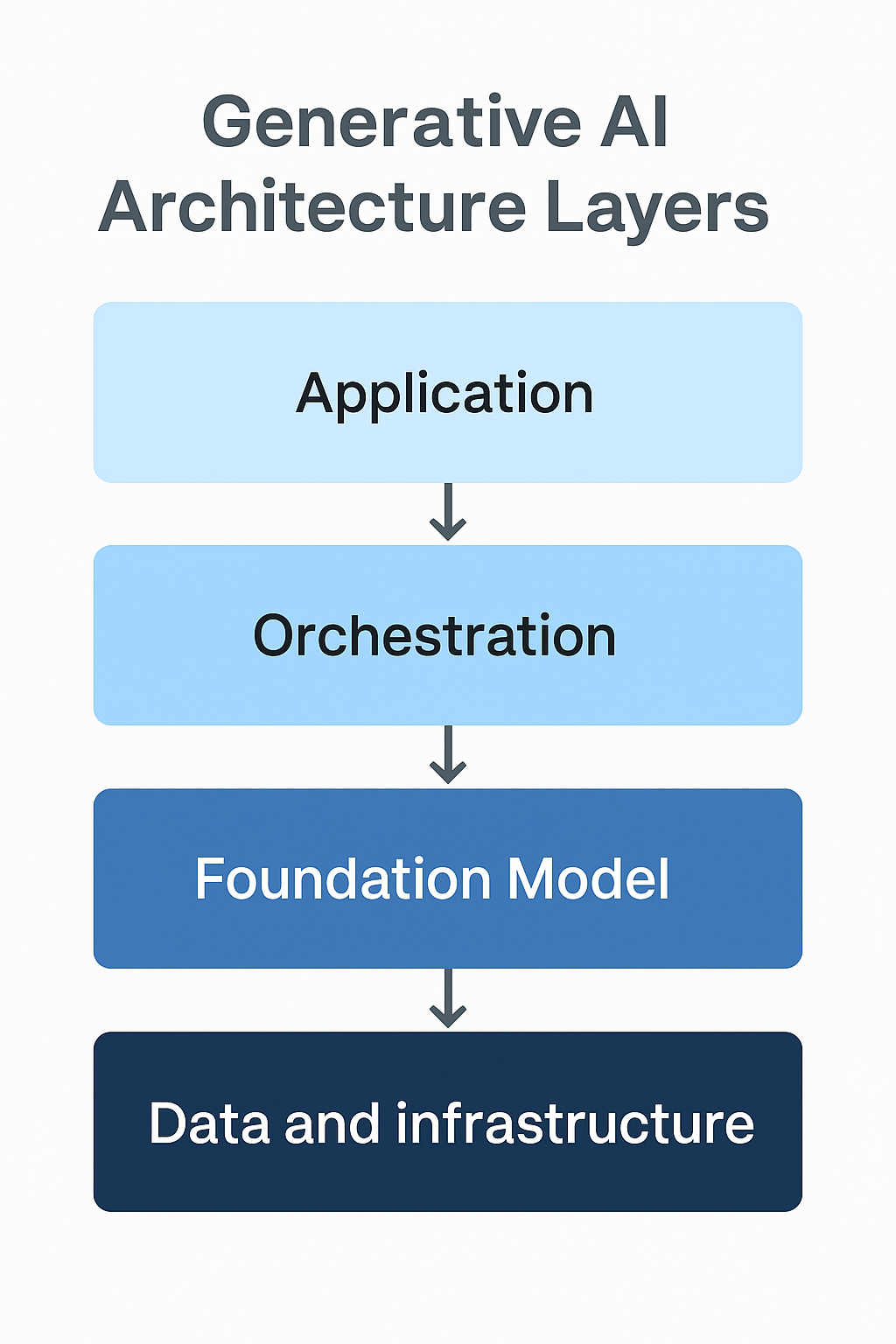
Gen AI as a Layer
Lesson 2: The Power Is in Niche-Specific Context
Generic models failed us. Success came from tailoring Gen AI to the specifics of the lending product:
-
For auto lenders, parsing dealer communications and title docs
-
For unsecured lenders, interpreting tone and intent from calls or chats
-
For credit-invisible applicants, building alternative credit profiles using web signals and public records
The value came from grounding Gen AI in domain-specific logic—not from asking it to be clever.
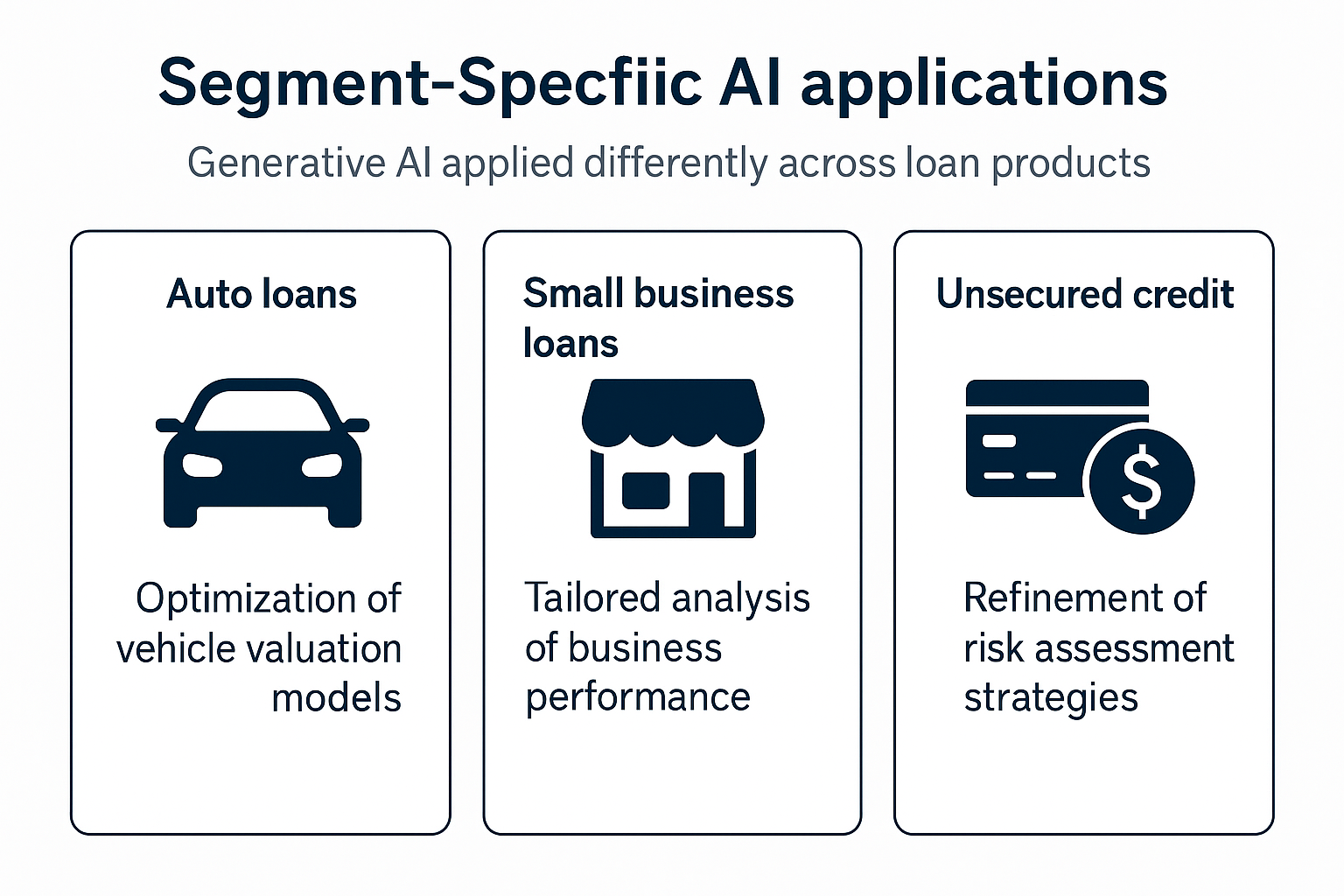
Niche AI Customization
Lesson 3: Explainability and Trust Are Make-or-Break
Lenders don’t just want speed—they need traceability. Our best outcomes came when we embedded:
-
Retrieval-based methods (RAG) for grounded answers
-
Prompt logs and human-in-the-loop editing
-
Explainability layers that supported both compliance and analyst trust
Gen AI that can’t be audited is Gen AI that won’t get deployed.

Where It’s Headed
We predict the future of credit risk will feature Gen AI in the following roles:
-
Copilot for Underwriters: Auto-summarizing, flagging, and recommending—but not deciding
-
Signal Amplifier: Surfacing behavioral, textual, or alt-data patterns legacy models miss
-
Compliance Ally: Generating auditable reasoning for edge-case approvals or declines
-
Continuous Learner: Improving based on analyst corrections and flagged decisions
The frontier is not about replacing human judgment. It’s about designing systems where human intuition, traditional models, and generative reasoning reinforce one another.
Final Word: Credit Risk Is Being Rewritten—Quietly, Intelligently
The promise of Generative AI in credit risk isn’t theoretical. It’s already reshaping how lenders underwrite, detect fraud, and serve harder-to-score segments.
But the lesson we’ve learned building decision engines across auto, unsecured, and niche lenders is clear:AI doesn’t replace the engine. It optimizes the fuel flow, tunes the ignition, and gives the driver a clearer view of the road ahead.
The next generation of lenders will win not by deploying flashy tools, but by embedding Gen AI where it makes real impact—inside workflows, under analyst fingertips, and within governance boundaries.
If you’re building for scale, for edge, and for trust, now is the time to lay that foundation.
→ Want to see how this looks in your organization? Let’s talk. Book a strategic session
Article tools