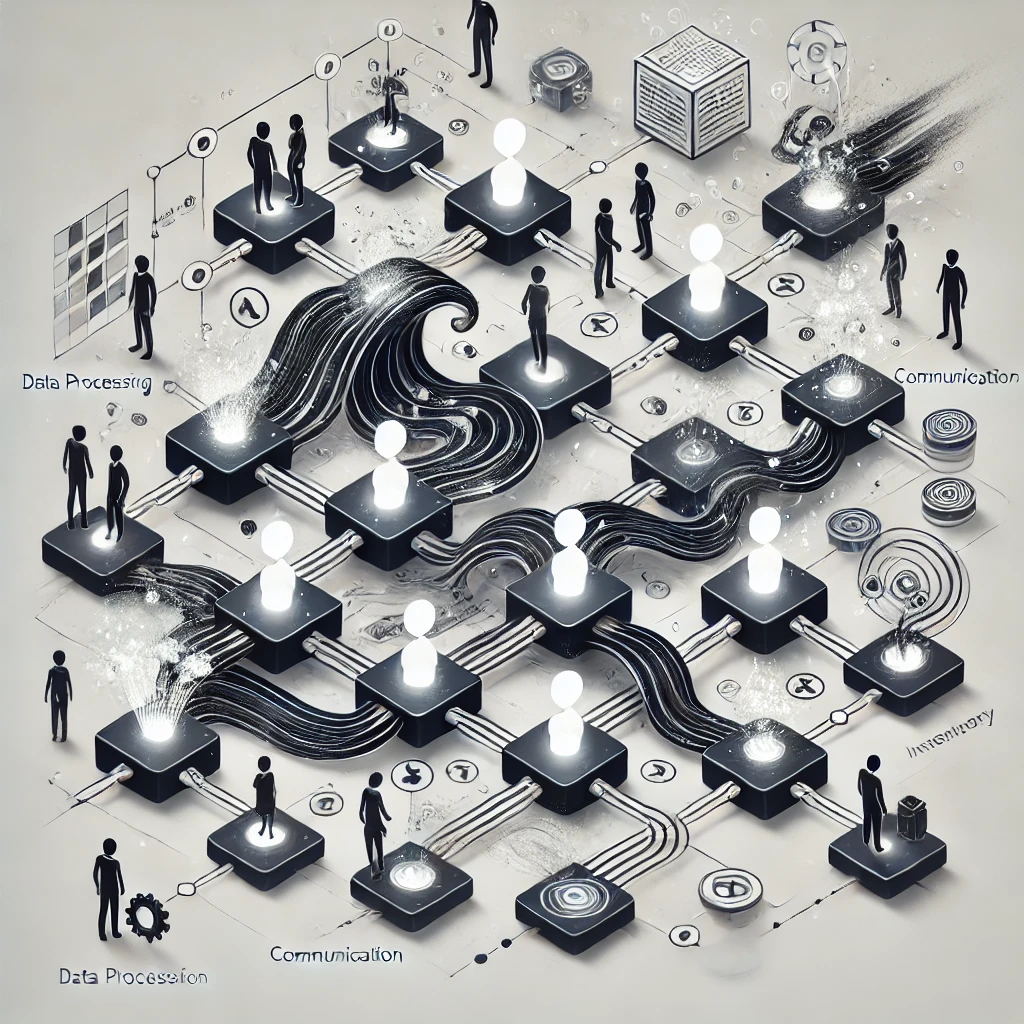
AI Agents and Enterprise Workflow
The Rise of AI Agents in Enterprises
Picture this: A team of overwhelmed employees is buried under piles of emails, struggling to extract meaningful insights from a sea of spreadsheets while juggling time-consuming tasks like scheduling meetings and approving purchase requests. Despite their best efforts, delays pile up, and errors sneak into the workflow. It’s a familiar scene in many enterprises. Now imagine the same team—but with an AI agent at their side. The AI swiftly organizes their tasks, flags critical items for attention, drafts reports, and even nudges team members to hit deadlines. What was once chaos is now a well-oiled machine.
This is the promise of enterprise workflow automation with AI agents: alleviating the burden of routine tasks, streamlining operations, and unlocking unprecedented levels of efficiency and innovation. Unlike traditional automation tools, AI agents don’t just follow rules—they learn, adapt, and make decisions in real time. They can predict problems before they arise, orchestrate complex processes across departments, and even serve as trusted advisors in decision-making.
The modern enterprise faces unprecedented challenges. Workflows are increasingly complex, data volumes are exploding, and employee time is stretched thin. In this environment, AI agents are emerging as a game-changing solution. These intelligent systems are designed to act autonomously, assisting humans in ways that go far beyond the capabilities of static tools. Whether it’s reducing delays in supply chains, improving customer response times, or optimizing resource allocation, AI agents are poised to transform how businesses operate.
Understanding AI Agents in Enterprise Workflow Automation
AI agents are not just the next evolution of automation—they’re a revolution in how work gets done. They hold the key to automating complex enterprise workflows. At their core, AI agents are autonomous software systems designed to perform tasks, make decisions, and even learn over time. Think of them as digital colleagues who never tire, forget, or deviate from their mission, yet have the intelligence to adapt to new challenges.
How Are They Different from Traditional Automation?
Traditional automation tools, like macros or robotic process automation (RPA), are rule-based and operate within rigidly defined parameters. While effective for repetitive tasks, these tools struggle to handle complex, unpredictable scenarios. AI agents, by contrast, thrive on complexity. Powered by machine learning, natural language processing (NLP), and other AI technologies, these agents can interpret context, adapt their actions, and even anticipate future needs.
Key Characteristics of AI Agents
-
Autonomy: AI agents can operate without constant human intervention. Once deployed, they make decisions and execute tasks based on their training and real-time data.
-
Context Awareness: Unlike traditional systems, AI agents understand the bigger picture. For example, an agent handling supply chain management doesn’t just reorder stock—it factors in demand forecasts, vendor lead times, and even market conditions.
-
Continuous Learning: AI agents learn and improve with each interaction. This means they get better at their tasks over time, making fewer errors and delivering greater value.
Real-World Examples
-
Virtual Assistants: Tools like Microsoft’s Copilot or Salesforce’s Einstein can act as AI agents, helping employees draft emails, schedule meetings, or prioritize tasks.
-
Intelligent Operations: AI agents can optimize workflows in real time, such as reallocating delivery trucks during a traffic jam to ensure on-time deliveries.
-
Proactive Support: In customer service, AI agents don’t just respond to queries—they analyze sentiment, predict issues, and suggest solutions before customers even ask.
Key Areas Where AI Agents Will Transform Workflows
AI agents are not just a technological novelty; they’re catalysts for meaningful change in how enterprises operate. These intelligent systems are already making waves across industries by automating repetitive tasks, enhancing decision-making, and orchestrating complex workflows. Here’s how they’re revolutionizing the workplace:
A. Automating the Repetitive
Repetitive tasks are the bane of enterprise efficiency. Whether it’s data entry, report generation, or basic customer queries, these activities consume valuable time that could be better spent on strategic initiatives. AI agents excel in taking these tasks off the hands of employees.
-
**Example Use Case:**Picture an accounts payable team burdened with manually processing invoices. An AI agent can automatically scan invoices, cross-check data with purchase orders, and flag discrepancies—all without human intervention.
-
**Impact:**By automating these mundane tasks, AI agents reduce errors, speed up workflows, and free employees to focus on high-impact work.
B. Enhancing Decision-Making
Enterprises run on decisions—big and small. But decision-making can be slow and error-prone, especially when it involves sifting through mountains of data. AI agents bring speed and precision to the table, analyzing vast datasets and providing actionable insights in real-time.
-
**Example Use Case:**In a retail environment, an AI agent can monitor sales trends, predict demand fluctuations, and recommend dynamic pricing adjustments to maximize revenue.
-
**Impact:**With AI agents, enterprises can make smarter decisions faster, giving them a competitive edge in dynamic markets.
C. Orchestrating Complex Workflows
Modern enterprises are ecosystems of interconnected teams, tools, and processes. Coordinating workflows across these silos can be a logistical nightmare. AI agents act as workflow orchestrators, ensuring everything runs smoothly.
-
**Example Use Case:**In a supply chain scenario, an AI agent can monitor production delays, adjust shipping schedules, and reroute deliveries in real-time to avoid bottlenecks.
-
**Impact:**AI agents not only increase operational efficiency but also minimize disruptions, saving time and money.
D. Enabling Proactive Problem Solving
AI agents don’t just react—they anticipate. By analyzing patterns and historical data, these agents can predict potential issues and take preemptive action to avoid them.
-
**Example Use Case:**A predictive maintenance AI agent monitors equipment health in a manufacturing plant, identifies early signs of wear and tear, and schedules maintenance before a breakdown occurs.
-
**Impact:**This proactive approach reduces downtime, extends asset lifespan, and optimizes resource allocation.
The Underlying Technology: How It Works
The magic of AI agents lies in the sophisticated technologies that power them. These systems are not just smart; they’re adaptable, context-aware, and capable of autonomous decision-making. Let’s break down the key technological pillars that enable AI agents to transform enterprise workflows.
A. Multi-Agent Systems
AI agents often work as part of a team, interacting with other agents or systems to achieve a common goal. This multi-agent architecture mimics the collaborative nature of human teams, where each agent has a specific role but operates in sync with others.
-
**Example:**In an e-commerce setting, one agent might handle inventory updates, another manages customer support, and a third optimizes delivery routes—all while sharing real-time data.
-
**Why It Matters:**Multi-agent systems allow for scalability and flexibility, enabling enterprises to tackle complex, interconnected tasks without a single point of failure.
B. Core Technologies Behind AI Agents
-
**Natural Language Processing (NLP):**Enables agents to understand and respond to human language, whether it’s via email, chat, or voice commands.
- Example: An agent parsing customer support tickets and assigning them to the right team.
-
**Machine Learning and Reinforcement Learning:**Allows agents to learn from data and improve their performance over time.
- Example: A sales AI agent refining its recommendations based on customer preferences and past behaviors.
-
**Generative AI:**Powers creative and decision-making capabilities, such as generating reports, composing emails, or drafting strategies.
- Example: An AI agent creating a personalized marketing campaign for different customer segments.
-
**Computer Vision:**Enables agents to interpret visual data, like images or videos.
- Example: A quality control agent in a factory using cameras to detect product defects in real time.
C. Integration with Enterprise Systems
AI agents don’t work in isolation—they integrate seamlessly with existing tools like ERP, CRM, and HR management systems. By acting as an intelligent layer on top of these platforms, they enhance functionality without requiring a complete overhaul.
- Example: An AI agent connected to a CRM system can analyze customer data to suggest upsell opportunities or prioritize leads based on predicted conversion rates.
D. Guardrails for Safety and Compliance
To ensure AI agents operate responsibly, enterprises employ guardrails like monitoring systems, ethical guidelines, and compliance checks. These guardrails prevent agents from making decisions that could lead to legal, ethical, or operational risks.
- Example: A financial AI agent that automates loan approvals is programmed to follow strict compliance rules, ensuring fairness and regulatory adherence.
E. Continuous Learning and Feedback Loops
AI agents thrive on feedback. Through reinforcement learning and user inputs, they adapt to changing environments and refine their behavior. This ensures that agents remain relevant and effective over time.
- Example: A customer service agent that learns from every interaction, improving its responses and resolution times with each query.
Why Enterprises Should Embrace AI Agents Now
AI agents are no longer a distant vision of the future—they are here, transforming the way enterprises operate, compete, and innovate. From automating repetitive tasks to orchestrating complex workflows, enhancing decision-making, and even driving strategic innovation, these intelligent systems are proving their value across industries.
The question for enterprises is no longer whether to adopt AI agents but how quickly they can begin leveraging them to stay ahead of the curve. The benefits are clear: increased efficiency, cost savings, better decision-making, and improved employee satisfaction. However, like any transformative technology, the key to success lies in starting small, learning fast, and scaling thoughtfully.
Start Your AI Agent Journey Today
To get started:
-
Identify High-Impact Use Cases: Look for areas in your workflow that are repetitive, data-intensive, or prone to delays.
-
Begin with a Pilot Project: Test AI agents in a controlled environment to prove their value and build organizational confidence.
-
Foster a Culture of Collaboration: Educate your teams about the role of AI agents as enablers, not replacements.
-
Invest in the Right Infrastructure: Ensure your systems can support seamless integration and real-time data processing.
Enterprises that act now will not only streamline their operations but also position themselves as leaders in their industries. Enterprise workflow automation with AI agents is not just a technological advancement; it’s a partnership shaping the future of work.
Are you ready to transform your enterprise workflows? Let’s start the conversation today. Reach out to explore how AI agents can help your business achieve its full potential.
[
Lets Connect
](http://www.phenx.io/contact)
Article tools