In the fast-paced world of artificial intelligence, efficiency is key! With Large Language Models (LLMs) like OpenAI’s GPT becoming increasingly prevalent, optimizing them for better performance and lower resource consumption has become a top priority. Two techniques stand out in this optimization landscape: quantization and model distillation. Let’s dive into what these techniques are, why they’re valuable, and how they make LLMs faster, smaller, and more efficient!
What is Quantization?
Quantization is a technique used to reduce the precision of the numbers used in a model’s computations. Typically, AI models use floating-point arithmetic for operations, which, while precise, can be resource-intensive. Quantization transforms these floating-point numbers into integers or lower-precision floats, which require less computational power and memory.
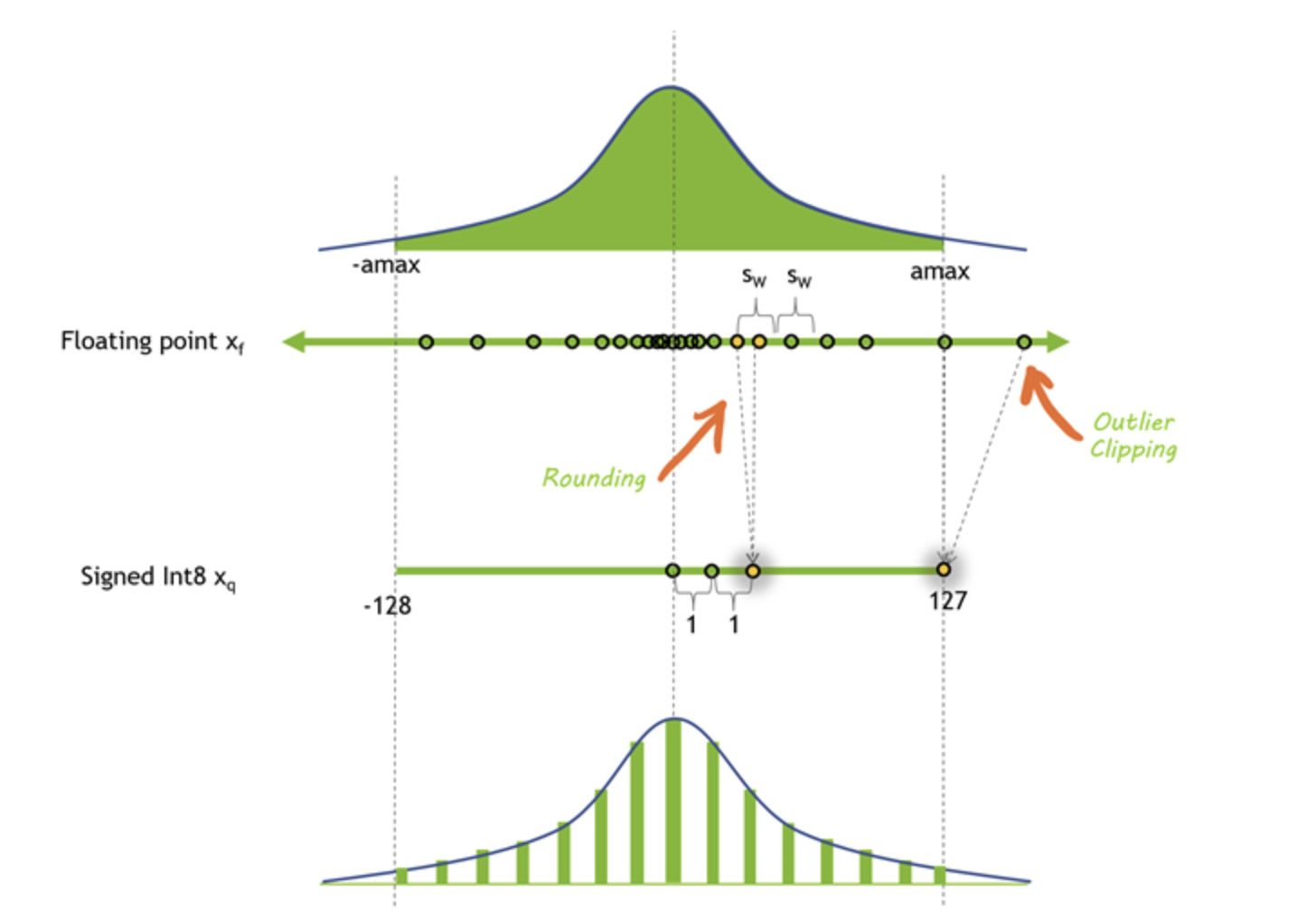
The distribution of values before and after one possible method of quantization. Source: https://developer.nvidia.com/blog/mastering-llm-techniques-inference-optimization/
The primary benefits of quantization are:
-
Reduced Model Size: By using lower-precision numbers, the memory footprint of a model is significantly decreased. This reduction is crucial for deploying models on edge devices like smartphones and IoT devices.
-
Increased Speed: Lower precision calculations are faster, which speeds up the inference time of the model without a significant loss in accuracy.
-
Energy Efficiency: Less computational overhead translates to lower energy consumption, which is vital for mobile and embedded applications.
There are several types of quantization:
-
Post-Training Quantization: Applied after a model has been trained, this method is simpler and doesn’t require retraining, but might lead to a higher loss in accuracy.
-
Quantization-Aware Training: This approach integrates quantization during the training process, allowing the model to adjust its parameters to the reduced precision, often resulting in better performance and minimal accuracy loss.
For LLMs, quantization can drastically reduce the size of the model by using 8-bit integers instead of 32-bit floating points. This reduction allows for deployment on consumer-grade hardware without a massive compromise on performance. For instance, quantizing a model like BERT or GPT-2 can reduce its size by nearly 75%, making it feasible to run on a smartphone.
What is Model Distillation?
Model distillation is another technique aimed at model optimization. It involves training a smaller model (the student) to replicate the behavior of a larger, already-trained model (the teacher). This process is not only about size reduction but also about transferring the capability of a complex model to a simpler one, which inherently requires less computational resources.
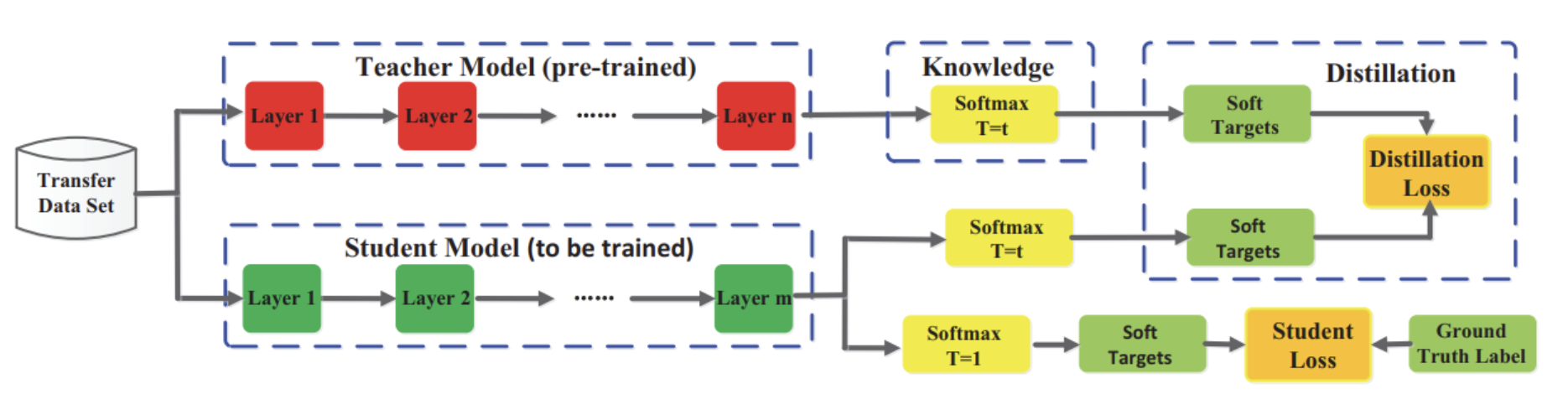
A general framework for knowledge distillation. Credit: https://arxiv.org/pdf/2006.05525
The process of model distillation includes:
-
Knowledge Transfer: The student model learns from the teacher model by mimicking its outputs on a given dataset. This often involves using the soft probabilities (logits) produced by the teacher as targets, which provide richer information than hard labels.
-
Performance and Efficiency: The distilled models typically retain much of the performance of the larger model but are more efficient in terms of computation and storage.
-
Flexibility in Deployment: Smaller models can be deployed in environments where computing power or memory is limited, such as mobile devices or in-browser applications.
Distillation has been used to create versions of LLMs that retain much of their original capability but are much smaller and faster. For example, DistilBERT is a distilled version of the BERT model that retains 97% of its language understanding capabilities but is 40% smaller and 60% faster.
Challenges and Considerations
While both techniques offer significant benefits, they come with challenges:
-
Accuracy Trade-Off: Both quantization and distillation can lead to a loss in model accuracy, which needs to be carefully managed. The extent of this loss varies depending on the technique and its implementation.
-
Complexity in Implementation: Integrating these techniques into the training pipeline requires additional expertise and resources, which can complicate the development process.
Conclusion
Quantization and model distillation are at the forefront of making AI more accessible and practical for real-world applications. By reducing the computational demands of LLMs, these techniques not only make it feasible to deploy advanced AI on edge devices but also help in reducing the environmental impact of running large models. As we continue to push the boundaries of what AI can achieve, optimizing how models are built and run will remain a critical area of research and development. By investing in these areas, businesses and developers can ensure that the benefits of AI are realized across all sectors of society, not just those with access to cutting-edge hardware.
Article tools